
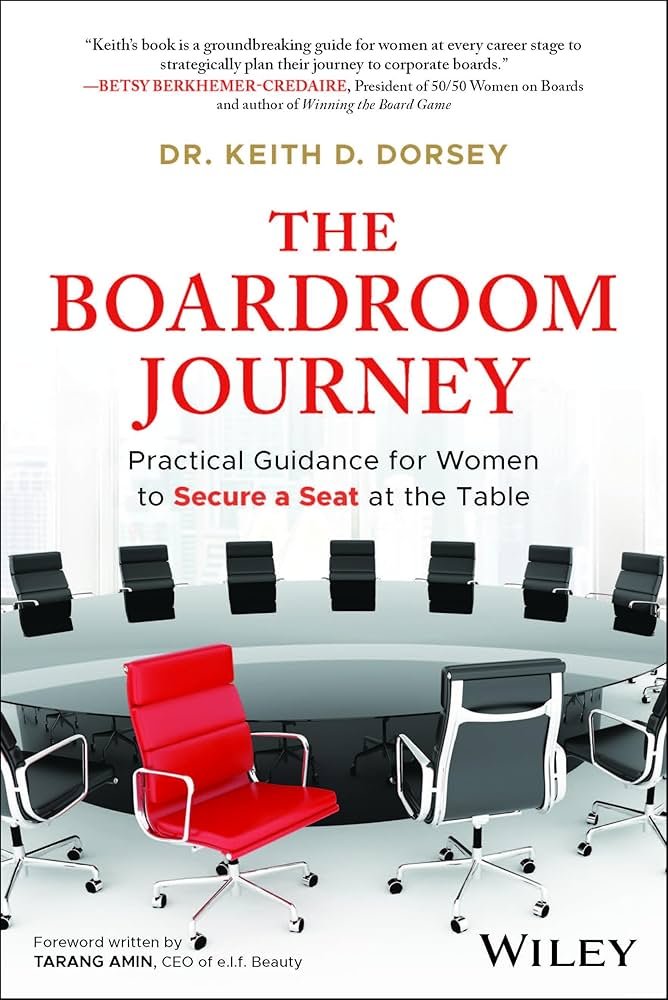
The Boardroom Journey by Dr. Keith Dorsey
Practical Guidance For Women to Secure a Seat at the Table
The Bottom Line Up Front (BLUF): Aspiring board members who cultivate purpose with resilience can earn a seat at the table and create lasting impact and legacy.
Executive summary
The Boardroom Journey book provides a roadmap for aspiring corporate directors, outlining the path from motivation to preparation and ultimately thriving in board service. Divided into three parts — Surveying the Landscape, Gearing Up for the Trek, and Navigating the Journey — it emphasizes self-awareness, skill-building, and resilience. Early steps include understanding board roles, discovering a clear personal “why,” choosing a general destination, and assessing readiness. Preparation centers on developing five forms of capital: cultural (unique perspectives), director (governance-specific skills), human (knowledge and growth), social (networks and credibility), and commitment (time and responsibility). Integrating these into a strong portfolio helps candidates demonstrate unique value and readiness. The journey also requires managing critics, building a trusted support team, and fail-proofing progress through clear goals and persistence. Ultimately, the boardroom is compared to a jungle — demanding, unpredictable, and rewarding only through effort. With preparation and resilience, directors can not only succeed but leave a lasting legacy.
The content
The book offers a clear roadmap for aspiring corporate board members, guiding them from initial motivation through preparation and into the complex world of board service. Divided into three sections — Surveying the Landscape, Gearing Up for the Trek, and Navigating the Journey — the book highlights self-awareness, skill development, and resilience as key to succeeding and thriving on the board.
In Part I, the journey starts with understanding what a board of directors is, what it does, and who serves on one. Boards are long-standing institutions responsible for oversight, management, and guidance of organizations, balancing involvement with a hands-off approach. While executives are judged by operational results, board members are evaluated by their ability to provide governance, oversight, and strategic advice without overstepping management.
A crucial early step is discovering your “why.” Securing a board seat is neither casual nor simple; it requires a clear purpose. People might pursue board service for personal fulfillment, to share expertise, to leave a legacy, or to instigate change in industries and organizations. Whatever the reason, it must be genuine and sustainable because board work demands significant effort.
Next, candidates must choose a destination. Boards vary greatly by industry, size, sector, and life cycle, all of which influence the qualifications and contributions expected of directors. While it is impractical to target a single company, establishing a general direction or “dream list” offers clarity.
Finally, one must assess board readiness. This involves recognizing strengths, identifying gaps, and finding opportunities to add value, all while aligning personal and professional goals with the board’s needs. Readiness is not static — it requires ongoing self-assessment and improvement.
In Part II, preparation focuses on developing five types of capital: cultural, director, human, social, and commitment. Together, these make up the portfolio a candidate uses to gain and succeed in a board role.
Cultural capital includes experiences, skills, and perspectives rooted in personal and professional backgrounds. Boards are increasingly seeking diverse ways of thinking to address global challenges, making cultural capital vital. Recognizing and expressing one’s unique perspective sets candidates apart and enhances the board’s collective decision-making.
Director capital encompasses the specific skills, training, and mindset needed for board service, which are different from those required for executive leadership. Successful executives must switch to a different role — shifting from operational management to oversight, strategy, and stewardship. Building director capital involves education, self-evaluation, and continuous practice. Since it is a long-term process, aspiring directors should regularly review their progress and seek training or experiences to address gaps.
Human capital involves intentionally developing knowledge, skills, and personal growth. Aspiring directors must regularly assess their abilities and make deliberate career choices aligned with board goals. Opportunities may appear unexpectedly, but each should be carefully evaluated for its suitability. Human capital not only attracts board attention but also ensures candidates bring relevant, current capabilities.
Board opportunities often arise through networks. It’s not just about who you know but also who knows you and views you as credible. Building social capital requires ongoing relationship development, assessment, and upkeep. By openly sharing board ambitions and fostering meaningful conversations, candidates boost their visibility and chances of being considered. Networking needs to be genuine and strategic, as hidden opportunities are often decided before formal processes even start.
Perhaps the most overlooked form of capital is commitment, which measures the willingness to dedicate time, energy, and responsibility to board service. Boards require preparation, attendance, and accountability, with directors facing both reputational and legal risks. Shareholder activism and litigation highlight the seriousness of board duties. Aspiring directors must fully commit — recognizing the timing, personal impact, and resources needed to sustain their role.
Ultimately, success depends on integrating all five capitals into a unified capital portfolio. This requires self-awareness, mentorship, ongoing learning, and developing a compelling board readiness narrative that clearly communicates value. Candidates must not only be capable executives but also demonstrate how their diverse portfolio makes them unique as directors. By strategically showcasing their portfolio, they enhance their chances of securing a board role and making valuable contributions once there.
In Part III, even with preparation, the journey to the boardroom is rarely easy. Success relies on managing mindset, overcoming challenges, and keeping momentum over what is often a multi-year process.
Aspiring directors inevitably face critics, skeptics, and competitors. Some may question their readiness, others may resist diversity, and some may hinder progress for personal benefit. Learning to identify, categorize, and neutralize naysayers is essential. Strategies include rephrasing criticism as growth chances, staying focused on long-term goals, and maintaining confidence in one’s path.
No journey is done alone. Mentors, peers, and advisors offer guidance, support, and accountability. A strong support team helps navigate career choices, avoid pitfalls, and keep momentum going. But, discernment is crucial — sharing goals too early or with the wrong people can backfire, as shows by cautionary examples. Candidates need to balance openness with discretion, making sure their support network is both safe and helpful.
Advancing to the boardroom takes years and involves setbacks. Fail-proofing involves developing strategies to prevent derailment: setting short-, medium-, and long-term goals; celebrating milestones; and adjusting plans as circumstances change. Motivation must be maintained through challenges by reconnecting with one’s “why.” Setbacks should be viewed as learning opportunities, and persistence must remain a key focus.
The final chapter highlights that the journey to the boardroom is long, demanding, and transformative. Unlike quick wins, serving on a board requires resilience, adaptability, and continuous self-improvement. The metaphor of the “jungle” reflects this reality: unpredictable, challenging, and demanding every step be earned through effort. For women and underrepresented groups, the challenges can be even greater, but the rewards are just as powerful.
Those who survey the landscape, prepare properly, and navigate with resilience can not only survive the boardroom jungle but also thrive, leaving a lasting impact on organizations and industries. The book concludes with encouragement: while the path is difficult, the rewards of purpose, influence, and legacy make the journey truly worthwhile.
Ten insightful quotes from the book
1. On attitude: “Any lack of preparation or cavalier attitude will be detected.”
2. On awareness: “When we understand and can articulate our specific attributes, we become able to differentiate ourselves based on what we will add to the boardroom.”
3. On selection: “Remain mindful to evaluate each twist and turn and then select those that complement and refine your path.”
4. On connections: “Knowing the right people is not enough.”
5. On legacy: “It is crucial that we prioritize building, consistently evaluating, and actively maintaining relationships throughout our professional journeys, particularly if we aspire to create a meaningful and influential legacy after retirement.”
6. On motivation: “When individuals are driven, they are more inclined to put in the necessary effort, concentrate their attention, and persevere in overcoming obstacles to successfully complete tasks.”
7. On service: “Board service is far from a walk in the park.”
8. On goal attainment: “Remaining committed, persistent, and resilient is vital to reaching your goals.”
9. On preparation: “You need to be prepared to deal with any kind of opponent, whether they are critics looking to improve their own self‐esteem or competitors who are out to win.”
10. On execution: “Delivering on a meaningful and compelling vision generally means you have some ground to travel to fulfill it.”
The wrap-up: why you should read The Boardoom Journey
The work of military veterans goes beyond just sharing wartime stories, trauma accounts, or leadership experiences. Their contributions can be more meaningful and impactful. The Boardroom Journey illustrates this well. It was written from many years of professional, corporate, real-world business experience and provides readers with a clear view of how corporate boardrooms truly operate, along with practical steps anyone can take to secure a seat at the table. Knowing the author personally, I read it as if I were talking to him, and if you know him like I do, you’ll see him as a mentor. That same friendly tone is present from the very first page. This book is about giving back and paying it forward, and I personally found its third part, part III, to be the most rewarding.
So, who is this book for? Let’s be clear: it’s written specifically for women because Dr. Dorsey has dedicated his career to studying the challenges many of them face in breaking into the boardrooms of our country’s top companies. In the book, you’ll learn about four women — Lauren, Denise, Sharon, and Michele — and follow their stories, which makes it personal. It is filled with development plans, assessments, evaluation strategies, action items, case studies, real quotes from executives, and both qualitative and quantitative data, along with countless references. In some ways, it feels like a dissertation since its foundational research was rooted there. However, it reads smoothly and practically, with each chapter offering the reader new insights, topics to reflect on, plans to develop, and steps to follow. The chapters progress logically, and my personal favorite is chapter eleven’s board readiness story: the elevator-pitch-like vignette of what makes you unique and why you’re a strong fit for a corporate board.
The book, however, appeals to a broader audience. If you’re aiming for a seat on a corporate board, this book is for you. It’s the clearest and most insightful resource available on how to achieve that goal. If you want to understand how corporate boards function, this book is for you; it explains the basics, shows how they’re structured, how they operate, and why. For MBA students, this book is essential; it broadens your perspective and offers insights as you start your corporate journey. And if you’re a military veteran who has led at a high level and hopes to continue your service by overseeing corporations, read this book and follow its guidance; it can help you reach your goal. Finally, if you’re already serving on a corporate board, you know the importance of concrete, reliable, and valid data. This book might be the push you need to do your part — perhaps to improve and ensure your boards are composed of the most qualified individuals, not just the most connected.
About the book’s author
Dr. Keith D. Dorsey is a researcher, author, board advisor, and corporate director dedicated to helping leaders and organizations optimize board governance and leadership effectiveness. As the founder of Boardroom Journey, he equips executives and aspiring directors with the knowledge and strategies needed to break barriers and secure independent director roles.
A National Association of Corporate Directors (NACD) Certified Director and 2023 NACD Directorship 100™ honoree, Dr. Dorsey combines extensive board experience, a doctorate in Organizational Change and Leadership, and deep research on achieving Optimal Diversity™ in corporate boards. His insights on governance, leadership, and executive career transitions have been featured in Harvard Business Review, MIT Sloan Management Review, Forbes, Fast Company, and Directors & Boards. His full archive of articles is available on the Boardroom Journey website.
Follow Dr. Keith D. Dorsey on LinkedIn
Book details:
The Boardroom Journey
Publisher: Wiley (May 6, 2025)
ISBN-10: 1394331789
ISBN-13: 978–1394331789
FOUND THIS POST USEFUL? PLEASE SUPPORT MY WORK.
As a leader and educator, I enjoy learning, sharing, reading, and writing, which are some of my passions. Besides my love for writing, I also write to share leadership lessons. Therefore, with every book I read and summarize, I consider how its content can be applied to teams and organizations, seeking impactful insights and quotes while identifying the right audience. I actively look for opportunities to apply what I’ve learned from each book and share that knowledge to improve myself, my teams, colleagues, peers, and anyone else working toward personal and professional growth with me.
While I often personally know the authors or have built relationships with them after reviewing, nothing about this process is sponsored or previewed. As a book reviewer, I am not paid to write reviews and am not influenced in how I create them. The process involves hours of reading and reflection, making it a significant effort, so I sincerely appreciate everyone who takes the time to like my content and subscribe to follow it.
Lastly, this review contains affiliate links. As an Amazon Associate, I earn from qualifying purchases. This means I may earn a small commission if you purchase through my links at no extra cost to you.
With that, thanks for reading!
Follow Dr. Jason Motes on LinkedIn
Subscribe to my newsletter, The Leadership Tea
Visit my website