
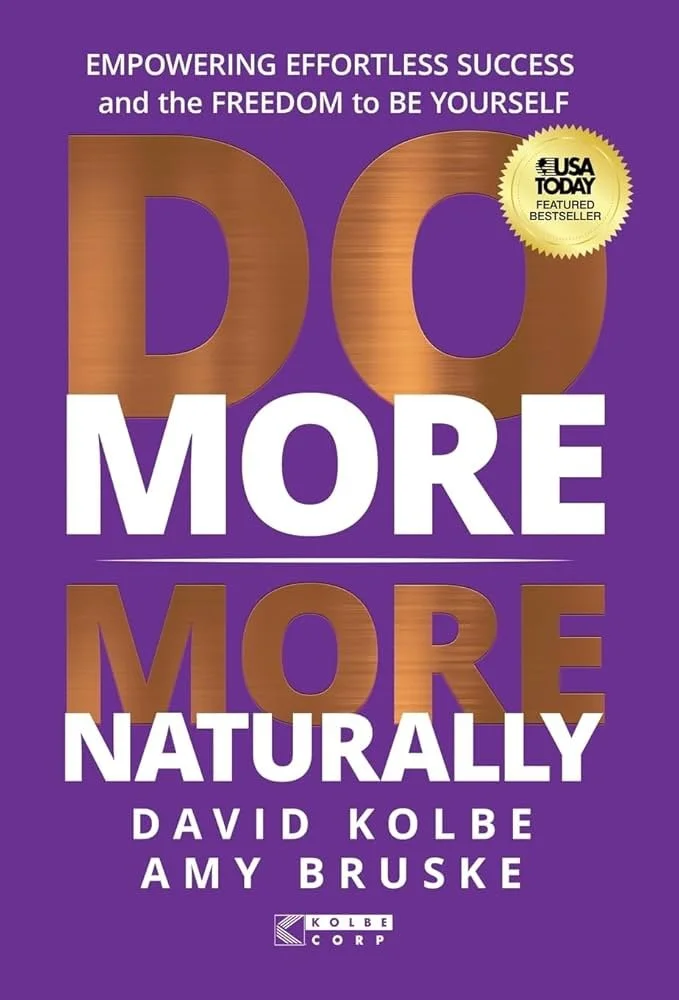
Do More, More Naturally by Amy Bruske & David Kolbe
Empowering Effortless Success and the Freedom to Be Yourself
The Bottom Line Up Front (BLUF): Sustainable success comes from embracing your natural strengths — understanding how you operate, committing to those strengths, and working with others to accomplish more.
Executive summary
Do More, More Naturally offers a compelling argument for redefining how we see success, productivity, and teamwork. Written from the perspective of Kolbe Corps and based on founder Kathy Kolbe’s decades of research into conation, the book encourages readers to shift away from the exhausting pursuit of success through force and imitation and instead embrace their natural strengths. Divided into three main sections — Clarity, Commitment, and Collaboration — the book provides a simple framework for individuals, teams, and organizations to achieve greater freedom, efficiency, and fulfillment by working in harmony with their innate instincts.
The content
Part I: Clarity
The opening chapters set the tone by challenging the idea that hard work must feel like an uphill battle. Chapter 1, “Why It Matters,” states that success is more sustainable and enjoyable when people recognize their strengths and those of others. The authors argue that readers tired of strict achievement standards will benefit most from this approach — especially those aiming to be productive without stress. They present the Kolbe philosophy as freeing and practical, based on the belief that everyone has innate strengths guiding them toward purpose and confidence.
Chapter 2, “Effortless Success,” urges readers to rethink success, suggesting it means ending the day with energy to spare, not exhaustion or meeting external standards. Many believe difficulty equals value, but working in harmony with instincts allows more achievement and vitality. The “Do More” isn’t about busyness but meaningful effort, and “More Naturally” means aligning actions with strengths to conserve energy and flow. The chapter introduces the Three C’s of Performance — Clarity, Commitment, and Collaboration — as the book’s foundation.
Chapter 3, “The Three Dimensions of the Mind,” links the book to science. The authors discuss the three parts: cognitive (reasoning), affective (feelings), and conative (action). While cognitive and affective are well-studied, conative is often overlooked despite its role in problem-solving. Kathy Kolbe’s research shows conation is innate and stable. Ignoring conative can lead to mismatched careers, burnout, and frustration, even for talented people. Tools like the Kolbe A Index help identify natural action modes — Fact Finder, Follow Thru, Quick Start, and Implementor — and where individuals excel.
Chapter 4, “Actions Speak Louder Than Words,” argues that true clarity happens when people understand how their natural strengths influence daily problem-solving. Using the Kolbe Index, individuals can learn how they naturally gather and share information, organize, handle uncertainty, and complete tangible tasks. Just like being forced to write with a non-dominant hand, working against one’s instincts wastes energy and causes frustration. On the other hand, knowing one’s conative strengths helps people focus their effort wisely, say “no” to work that isn’t aligned, and conserve energy for what matters most. The chapter ends Part I by emphasizing that understanding your innate strengths is the key to lasting productivity.
Part II: Commitment
If clarity reveals strengths, commitment determines whether individuals truly benefit from them. Chapter 5, “What Is Your Superpower?,” describes commitment as the discipline of consistently using one’s strengths and protecting mental energy from waste. The authors emphasize that mental energy is limited, much like fuel in a vehicle. Wasting it on trivial decisions or attempting to change innate traits leaves people drained and less effective. By committing to their natural abilities, individuals gain permission to say “no” to tasks outside their zone, thereby reducing stress and increasing productivity.
Chapter 6, “Good Advice Gone Bad,” critiques popular myths like the “10,000-hour rule,” which claims mastery depends solely on effort and persistence. While determination has value, the book argues that effort pushed against one’s natural instincts only creates “strong weaknesses.” The chapter stresses the importance of assessing advice based on personal strengths, rejecting one-size-fits-all solutions, and instead choosing paths that match one’s conative makeup.
Chapter 7, “It’s Time to Stop Swimming Against the Current,” emphasizes the risks of working against one’s nature. Constantly pushing beyond your instinctive zone results in burnout and lower effectiveness. Instead, the authors suggest that readers identify tasks they can release, delegate, or collaborate on, freeing themselves to focus on what they do best. In this context, commitment is not just about perseverance but about making smart choices on where to invest limited energy.
Chapter 8, “Recharging Your Battery,” concludes the section by emphasizing the importance of rest and renewal. Procrastination, often viewed as a flaw, is reinterpreted as a signal: tasks that repeatedly slow us down may fall outside our natural zone or require more energy than we currently have. Instead of pushing harder, readers are encouraged to recharge, delegate, or rethink their priorities. The chapter highlights that peak performance depends on cycles of rest as much as effort.
Part III: Collaboration
The final section shifts focus from individual strengths to the collective power of teams. Chapter 9, “Making Beautiful Music,” compares collaboration to an orchestra: productivity increases when individuals combine their unique strengths in harmony. The authors differentiate between working with “clones,” who share similar instincts, and “complements,” who bring different approaches. Both have value, depending on the situation. Effective collaboration also involves what the authors call “conative communication” — acknowledging that instincts influence not only how people work but also how they express themselves.
Chapter 10, “The Beauty of Diversity,” expands this metaphor by illustrating that diverse teams outperform homogeneous ones. Just as in finance, diversity pays dividends: with a range of problem-solving skills, teams can tackle challenges more effectively and creatively. The book warns leaders to understand each member’s conative strengths so they can assign roles that maximize their contributions, similar to strategically positioning chess pieces.
Chapter 11, “Developing a Strengths-Based Culture,” examines how these principles can transform organizations. When companies cultivate cultures that respect natural strengths, engagement increases and turnover decreases. By shifting away from ego-driven management and appreciating diverse approaches, organizations can balance results with freedom, fostering healthier and more sustainable workplaces.
Chapter 12, “Tag, You’re It!,” simplifies the book’s message into a three-step process: understand your natural strengths, commit to using them wisely, and work with others whose strengths complement yours. This approach, the authors say, helps individuals and teams achieve more with fewer resources, less conflict, and stronger relationships.
Finally, Chapter 13, “Taking Action,” presents the practical tools provided by Kolbe Corp, including assessments for youth and families, highlighting the wide applicability of the conative model beyond workplaces to personal relationships and education.
Ten insightful quotes from the book
1. On being ourselves: “Everyone longs for the freedom to be themselves.”
2. On knowing yourself: “You can’t really have clarity about who you are if you don’t understand the way you think and feel.”
3. On burning energy: “When we work against our natural conative strengths, we work slower, get frustrated, and expend more mental energy.”
4. On self-change: “Attempting to change our innate traits resembles a fish struggling to climb a tree.”
5. On collaboration: “Commitment to operating at your best means finding others whose strengths are a better fit.”
6. On letting go: “As we let go of things that don’t fit, we make room for the tasks that better use our mental energy.”
7. On grace: “You deserve to figure out exactly how to find the freedom to be yourself.”
8. On recharging: “Sometimes you need to stop striving and do nothing.”
9. On teams: “The most successful collaborative teams are filled with complements.”
10. On strength diversity: “The idea that working with people whose strengths complement each other produces better results isn’t wishful thinking; it’s reality.”
The wrap-up: why you should read Do More, More Naturally
After recently completing Kolbe’s Certified™ Consultant training, I was eager to read this book and dive into it; the concepts developed and offered by Kolbe Corps are fascinating and relevant to my daily leadership work. Do More, More Naturally is designed to help us recognize that we have inherent, identifiable strengths that we can learn to use more effectively and leverage to achieve what matters most to us. As the authors mention in the book, if you focus heavily on improving your weaknesses, you’ll probably get better at them, but you’ll ultimately end up with simply strengthened weaknesses.
I’ll share a personal example to illustrate this point. As a high school high jumper, I was skilled at jumping off both legs, which meant I could approach the bar from either side. One day, my coach, who was an Olympic jumper, asked me to focus on my approach and to help me decide which leg to jump off permanently. He had me stand still as if I were in a military “attention” pose. Then, he walked behind me and pushed on my back, forcing me to lunge forward. My natural tendency was to take my first step with my right leg, and from that moment on, I began jumping off my right leg. It felt natural, and I started improving my jump metrics more easily. Sure, I could have kept jumping off my left leg, but I might have hit a limit since it wasn’t my natural strength. When it comes to our minds and conative strengths, that idea is very relatable.
It doesn’t seem very appealing to swim upstream when we could instead direct that same mental energy toward our unique strengths and natural talents, where there may be no limit. Now, imagine the possibilities for our lives if we had been doing this from the very start of our careers. Suddenly, everything becomes clearer. And like the authors suggested through their personal stories, you might even be thinking to yourself, “wow, I wish I’d known this years ago, when I was struggling in a particular role or with a specific project.” Just consider how different the outcomes could have been if you had known then what you know now about conative strengths.
So, who is this book for? It was written for everyone because conative strengths apply to all. But let’s be clear: it’s not a self-help book or a management 101 guide. It won’t teach you how to improve your thinking, hold people accountable, or give more effective feedback. However, it will provide insight into why paying close attention to your conative strengths (and those of your peers and teams) matters, especially if you’re in a leadership role or aspire to be in one. Because if you can improve things like communication, conflict, and efficiency by investing a bit in yourself and others, you may significantly impact yourself, your team, and your organization — both directly and indirectly. That’s what happens when the metaphorical light turns on, and that’s what you’ll discover when you read Do More, More Naturally.
About the book’s authors
Amy Bruske is the expert voice for real-world applications of the Kolbe Concept® — the authoritative theory for human instinct and performance. As president and co-owner of Kolbe Corp she helps entrepreneurs, corporate leaders, parents, and other consultants Do More, More Naturally, by tapping into the power of their own and others’ conative strengths.
As President and an owner of Kolbe Corp, she spends her days advising Fortune 500 companies, top government agencies, and rapidly growing small businesses about how to do more, more naturally. Her innovative training programs empower a global cohort of high-impact consultants and hundreds of teams each year to harness the power of instinctive strengths. Amy’s provocative speeches and interactive workshops have propelled Kolbe Corp’s global impact, supporting entrepreneurs, emerging leaders, and driven consultants to achieve effortless performance.
She partnered with renowned theorist Kathy Kolbe to author “Business is Business,” the groundbreaking family business guide. Amy serves as Chairman of the Board for the Center for Conative Abilities and is also a member of the Women Presidents’ Organization, the International Women’s Forum, the Phoenix Blue Business Council, Charter 100, and the Strategic Coach program. She currently serves on the board of the Arizona Hispanic Chamber of Commerce and has also served on the board for the National Association of Women Business Owners.
David Kolbe is transforming how the world understands human performance. He comes from a lineage of psychometric pioneers and is the CEO of Kolbe Corp, a company committed to helping people achieve what they care about most. David has lived and breathed the Kolbe Concept® and helped develop the original algorithm for the Kolbe A™ Index — the only proven tool to unlock instinctive strengths.
He’s passionate about helping people discover their strengths, reduce their stress, and find more joy at work and home. Top companies call David because he knows the secret to unleashing innovation and building teams that thrive, and has the scientific validation to back it up. David is known for his speeches and workshops that blend wit, interactivity and introspection. With a rich background in law and business, David has an exceptional knack for turning innovative ideas into profitable ventures.
Before he joined Kolbe Corp, David was an attorney at a top Arizona law firm and a Legislative Director in Congress. He also holds a degree in economics from the Wharton School of Business. When he’s not at work, you can find David skiing down a mountain, playing poker, or immersing himself in music. He calls Arizona home
Follow David Kolbe on LinkedIn
Book details:
Do More, More Naturally
Publisher: Ethos Collective (October 15, 2024)
ISBN-10: 1636803385
ISBN-13: 978–1636803388
FOUND THIS POST USEFUL? PLEASE SUPPORT MY WORK.
As a leader and educator, I enjoy learning, sharing, reading, and writing, which are some of my passions. Besides my love for writing, I also write to share leadership lessons. Therefore, with every book I read and summarize, I consider how its content can be applied to teams and organizations, seeking impactful insights and quotes while identifying the right audience. I actively look for opportunities to apply what I’ve learned from each book and share that knowledge to improve myself, my teams, colleagues, peers, and anyone else working toward personal and professional growth with me.
While I often personally know the authors or have built relationships with them after reviewing, nothing about this process is sponsored or previewed. As a book reviewer, I am not paid to write reviews and am not influenced in how I create them. The process involves hours of reading and reflection, making it a significant effort, so I sincerely appreciate everyone who takes the time to like my content and subscribe to follow it.
Lastly, this review contains affiliate links. As an Amazon Associate, I earn from qualifying purchases. This means I may earn a small commission if you purchase through my links at no extra cost to you.
With that, thanks for reading!
Follow Dr. Jason Motes on LinkedIn
Subscribe to my newsletter, The Leadership Tea
Visit my website