
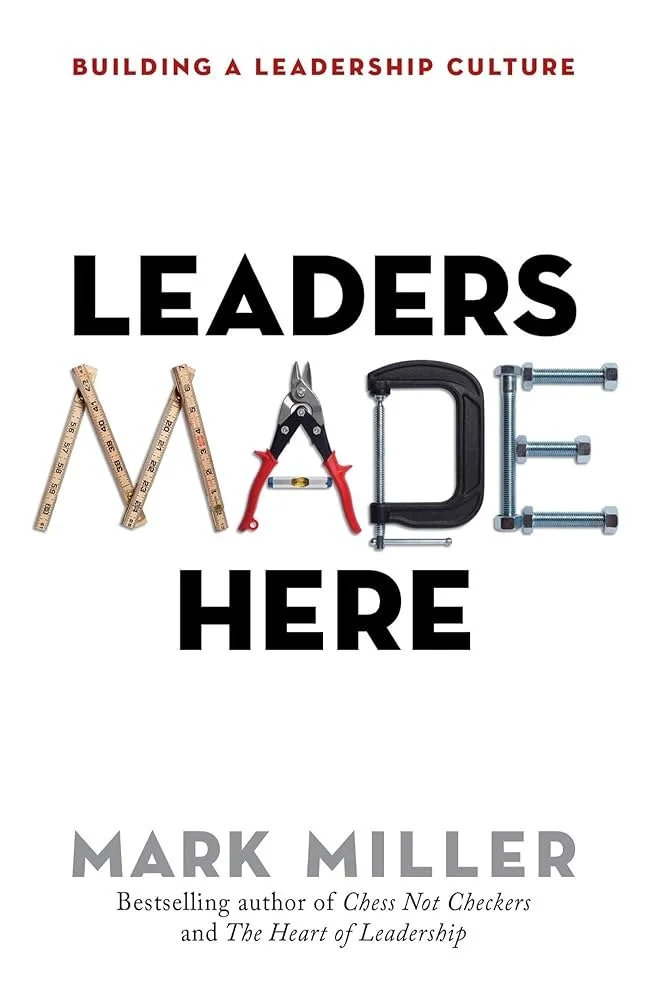
Leaders Made Here by Mark Miller
Building a Leadership Culture
The Bottom Line Up Front (BLUF): Leaders who want to be great must be willing to serve.
Executive summary
To achieve something greater than oneself, you can’t do it alone. That’s the story of Blake, an accomplished Chief Executive Officer brought in to lead an underperforming company, and his colleague, Charles, an experienced and long-tenured Human Resources executive assigned to help build a sustainable leadership culture. Leadership cultures develop when leaders are consistently and systematically nurtured, and when there is a surplus of leaders ready for the next opportunity or challenge. Through careful exploration of topics and assessment of the leadership landscape within the organization and comparable organizations nearby and beyond, along with a team of dedicated change agents, a leadership pathway is mapped out to drive results and foster long-term leadership growth in an organization that lacks the core elements of a leadership culture.
The content
The book centers on the story and enduring professional friendship between Blake, an accomplished CEO, and Charles, a successful Human Resources executive and thought leader. Blake was brought in to turn around a struggling company, and shortly after his arrival, the company faces an unthinkable tragedy caused by a lack of leadership and accountability. In reflection after the tragedy, his intuition that the company lacks a sustainable leadership culture proves correct, and the book’s storyline begins by guiding the reader through a journey of exploration to develop and implement a sustainable leadership culture based on proven leadership principles identified through alignment and diligence.
The book begins by recognizing that leadership is the foundation of all great organizations. However, it identifies four common objections leaders face when trying to introduce leadership development: apathy toward building a leadership culture, disbelief that leaders can be developed, lack of commitment to fostering a leadership culture, and a deficiency in curiosity and desire for innovation to learn how to do it.
The CEO recognizes that the only limit on the organization’s future growth is the number of leaders it can develop and invests in building a team to establish and uphold a leadership culture. This begins by cataloging the different definitions of leadership within the organization. The team reaches an agreement to align and develop a shared definition of leadership, emphasizing that the leadership culture is simply the consistent behaviors of its members.
After establishing their charter, the team evaluates their organization’s leadership culture and considers options for improvement. Discussions with multiple senior stakeholders reveal that the issue is much larger than initially believed, leading to research on companies that excel at developing leaders. This research results in a series of interviews with senior leaders in other organizations regarded as having a competitive advantage due to their cultures.
By studying the best practices of successful firms across industries, they identify the values and traits that emerging leaders should embody and understand activities that promote growth and strengthen leadership cultures. This benchmarking effort leads to significant breakthroughs, enabling the team to compile lists of best practices, key takeaways, and ideas for implementation within their own organization.
Among the key lessons learned from these benchmarking activities are finding ways to give emerging leaders real-world leadership opportunities, avoiding impractical practices, establishing meaningful mentoring programs, securing support from senior-level management, and designing objectives that are both appropriate and unique to the firm. They also recognize the importance of using the right metrics to evaluate and improve leadership development, and most importantly, the idea of walking the talk — where senior leaders demonstrate the principles they promote within the leadership culture.
The team concludes their work by creating and refining a list of leadership imperatives: Teach it, to ensure everyone understands the organization’s leadership perspective and that leaders have the necessary skills; Practice it, which involves creating opportunities for leaders and emerging leaders to lead; Measure it, to track the progress of leadership development efforts; and Model it, emphasizing leading by example — since people always observe their leaders. The book wraps up with some insights into the team’s implementation and the successes experienced afterward, including promotions and growth.
Ten insightful quotes from the book
1. On responsibility: “Leaders are responsible for the culture in an organization.”
2. On data: “The truth is always better than a bad assumption.”
3. On culture: “Culture is not what you want it to be — it is what people do on a regular basis.”
4. On advantage: “Leadership is the only sustainable competitive advantage.”
5. On development: “If you can create a culture in which growing leaders is part of your DNA, you can always position yourself to win.”
6. On sustainability: “A leadership culture exists when leaders are routinely and systematically developed and you have a surplus of leaders.”
7. On metrics: “Nothing improves without measurement, and leadership is no exception.”
8. On ineptitude: “The one thing that can prevent you from creating a leadership culture is leadership.”
9. On apathy: “The number one reason most companies do not have a leadership culture is their current leadership.”
10. On exemplification: “People always watch the leaders.”
The wrap-up: why you should read Leaders Made Here
It’s been many years since I last read a fable — a book that teaches lessons through a fictional story rather than through history, opinion, anecdotes, or facts. Over the past twenty years, I can count on one hand how many I’ve read. Yet, there’s something about them that makes them engaging, and truly good ones can communicate a message of learning simply and in the most relatable way. Leaders Made Here is one of those stories.
Part of a five-book series called the High Performance Series, the book’s story of a CEO brought in to steer a ship will captivate the reader and draw them into the text, as if they are actually on the pages, in the workplace, working alongside the characters as a team. But it’s the goal of the text that truly draws the reader in: building a leadership culture and finding the right way to get started. As the book’s main characters realize, doing so is harder than one might expect.
So, who’s this book for? Well, for starters, if you’re a CEO or in a leadership position of significant influence, whether you’ve just taken the helm of a company or are about to, this book offers important ideas for you. Why? Because sustaining a leadership culture isn’t just something you talk about; it’s something you intentionally develop and nurture, and the book provides the blueprint to do so. It’s also not something any executive leader can negotiate with. You’re either committed to building and sustaining one, or you aren’t — and those who aren’t simply won’t last.
But let’s say you’re not there yet and you aspire to be; the book provides some examples of what you’ll likely encounter along the way: skepticism, cynicism, apathy, and genuine resistance. Change, whether positive or negative, is hard to implement, and Leaders Made Here explains why. The lessons learned from this concept are among its most compelling stories. But there’s also a hidden message in the book about grace. At some point in everyone’s professional lives, we face challenges. The positive message of using a support system and meaningful, constructive, purposeful work to overcome real-world difficulties is inspiring, and many will connect with the book’s underlying theme of perseverance. If you’re looking for a compelling story about what it takes to step in and step up — regardless of organizational size or mission — Leaders Made Here is perfect for you.
About the book’s author
Mark Miller is an international best-selling author, business leader, and communicator.
Mark began writing almost twenty years ago when he teamed up with Ken Blanchard, co-author of The One Minute Manager, to write The Secret: What Great Leaders Know and Do. The book you now hold in your hand is his seventh. With over 1,000,000 books in print, in more than 25 languages, Mark’s global impact continues to grow.
In addition to his writing, Mark enjoys speaking to leaders. Over the years, he’s traveled to dozens of countries teaching for numerous international organizations. His theme is always the same: encouraging and equipping leaders!
Mark started his Chick-fil-A career working as an hourly team member in 1977. In 1978, he joined the corporate staff working in the warehouse and mailroom. Since that time, he has provided leadership for Corporate Communications, Field Operations, Quality and Customer Satisfaction, Training and Development, and Leadership Development. During his tenure with Chick-fil-A, the company has grown from 75 restaurants to over 2,300 locations with annual sales approaching $10 billion.
Mark lives an active lifestyle. As a photographer, he enjoys shooting in some of the world’s hardest-to-reach places, past locations include: Antarctica, Everest Base Camp, the jungles of Rwanda, and the Galapagos Islands. Married to Donna, his high school sweetheart, for over 35 years, Mark has two sons, Justin and David; a daughter-in-law, Lindsay; and three amazing grandchildren.
Learn more about Mark: https://www.markmillerleadership.com
Follow Mark Miller on LinkedIn
Book details:
Leaders Made Here
Publisher: Berrett-Koehler Publishers (March 13, 2017)
ISBN-13: 978–1626569836
FOUND THIS POST USEFUL? PLEASE SUPPORT MY WORK.
As a leader and educator, I enjoy learning, sharing, reading, and writing, which are some of my passions. Besides my love for writing, I also write to share leadership lessons. Therefore, with every book I read and summarize, I consider how its content can be applied to teams and organizations, seeking impactful insights and quotes while identifying the right audience. I actively look for opportunities to apply what I’ve learned from each book and share that knowledge to improve myself, my teams, colleagues, peers, and anyone else working toward personal and professional growth with me.
While I often personally know the authors or have built relationships with them after reviewing, nothing about this process is sponsored or previewed. As a book reviewer, I am not paid to write reviews and am not influenced in how I create them. The process involves hours of reading and reflection, making it a significant effort, so I sincerely appreciate everyone who takes the time to like my content and subscribe to follow it.
Lastly, this review contains affiliate links. As an Amazon Associate, I earn from qualifying purchases. This means I may earn a small commission if you purchase through my links at no extra cost to you.
With that, thanks for reading!
Follow Dr. Jason Motes on LinkedIn
Subscribe to my newsletter, The Leadership Tea
Visit my website