
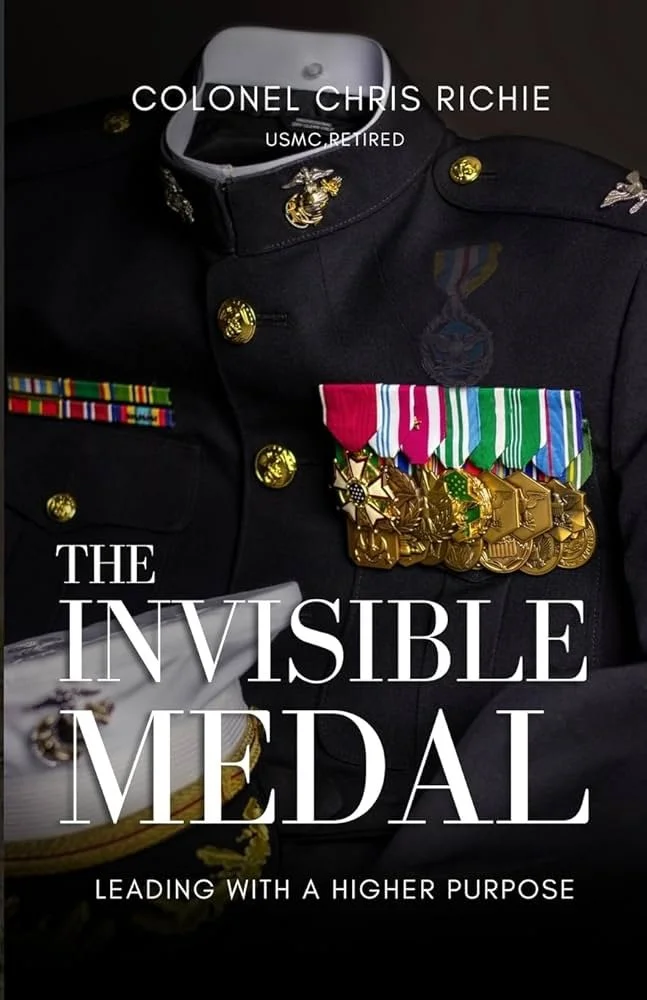
The Invisible Medal by Chris Richie
Leading With A Higher Purpose
The Bottom Line Up Front (BLUF): Success is irrelevant when compared to influence and significance that positively impact others’ lives.
Executive summary
Serving others is the highest calling, and anyone who wants to lead must first serve. Servant leadership involves prioritizing the well-being of those we care for above all else. When leaders focus on their people and relationships, viewing leadership as a form of stewardship — and recognizing everyone’s potential — they can earn the “invisible medals” of leadership. To earn these medals, servant leaders must prioritize people and relationships, see life as a form of stewardship, and believe in everyone’s potential. The journey to become and act as a servant leader requires faith, patience, and a deliberate commitment to follow a specific path. Through ethical choices, strong character and values, and honoring cultural principles, leaders can reach their purpose-driven destination the right way. When servant leaders help others achieve self-actualization, make a difference in someone’s life, and are recognized for that impact, they earn the most valuable of all medals: The Invisible Medal.
The content
Comprised of ten chapters and numerous references, The Invisible Medal is a practical guide that includes 30 reflective questions to help readers navigate the journey of purpose-driven leadership.
Chapter One, “The Invisible Medal,” introduces the concept of giving and receiving “invisible medals,” which is the book’s central theme. The chapter highlights this idea through servant leadership, including the author’s background and his realization that every person is gifted with life and that each individual’s contribution is, in turn, their gift to humanity. There’s a mention of a mission in an undisclosed location that resonates with those who have experienced marching with the United States Marine Corps. While the chapter briefly states that the ribbons and medals on a person’s chest are often linked to their achievements, it suggests that the more meaningful medals are the unseen ones connected to a higher purpose and mission. Ultimately, it shows that servant leaders care less about recognition and more about the impact they have on others’ lives.
Chapter Two, “Finding Purpose,” begins with a notable quote from Mark Twain about discovering one’s personal why. The chapter explores the life of Col. Eugene Conrad, the author’s grandfather, a decorated World War II veteran and survivor of a prison war camp. The author shares cherished moments with his grandfather and sees that he found his purpose in life through him. The chapter also covers his upbringing in Texas and how a game day afternoon at the Cotton Bowl inspired him to travel to Alabama for college at Auburn University, where the roots of his character were formed.
Chapter Three’s “Finding Your Story” can be summed up with one word: reflection. It examines the art of storytelling and the idea that sharing messages that connect with people and inspire them is powerfully life-changing. It also highlights that the shortest distance between two people is a good story. The chapter recognizes that each person has a unique narrative and introduces the concept of life crucibles, set against the backdrop of the Marine Corps’ crucible event in boot camp. The author believes that crucible events in life can reveal a leader’s hidden reservoirs of resilience and concludes with personal lessons from his own experiences.
In Chapter Four’s “A Leadership Philosophy,” the author begins to introduce his ideas about leadership, emphasizing that every team member wants and needs to feel valued. The chapter explores common reasons why military personnel leave the armed forces, which helps the author develop his personal leadership philosophy called “TEAM,” an acronym for “Train, Empower, Acknowledge, and Mentor.” It also effectively links military attrition rates to civilian organizational attrition rates by highlighting similarities between the two, both related to a general lack of leadership effectiveness.
Chapter Five starts by emphasizing that few leaders aim to be poor ones and then reminds leaders that their people are always watching — a sobering yet relevant way to remind them how they are perceived and why it matters. It also points out that purpose-driven leadership brings unseen rewards, and the author introduces a roadmap based on values, ethics, character, and culture to help leaders achieve this. Chapters six through eight examine three of these purpose-filled guidelines: Values, Ethics, and Character. Beginning with how values influence decision-making, the author encourages leaders to reflect on the core values that define them and serve as principles that remain constant regardless of circumstances. The chapter on values also highlights the timeless concept of “failing forward,” which relates to the learning process.
In Chapter Seven, which focuses on ethics, the author discusses the challenges of prioritizing ethics over values but reminds readers that their actions matter, providing relevant examples of how to manage those priorities in difficult dilemmas and situations. It also includes a short, yet poignant story about a military scenario abroad. Chapter Eight explores character and how its consistency is crucial in leadership. The author also appropriately states that character can act as a “leadership multiplier” and that it forms the foundation of leadership philosophies. Finally, the chapter on character introduces CARE — an acronym describing a process, illustrated by vignettes from Nicaragua and Haiti, along with the author’s personal leadership experiences.
Chapters nine and ten thoroughly explore culture. They are insightful, offering examples of cultures within highly successful organizations along with real-life anecdotes. The author explains a culture’s origins and how it acts as a force guiding organizational behavior, decision-making, and alignment with organizational missions and goals. There is also a strong warning that cautions readers (and leaders) against those who try to shape culture to fit their personal beliefs and interests. Finally, the chapters on culture highlight the leader’s role in shaping culture, including how to achieve the best outcomes when different cultures clash.
Intentionally, in the book’s final chapter, the author pays homage to a culture whose identity is unmistakable: the U.S. Marine Corps. He skillfully reminds readers of its “leaders eat last” belief system and how prioritizing the well-being of those under his care was one of his core lessons as a Marine Officer. He shares a heartfelt story about a very special Marine and concludes by summarizing the myths, legends, and legacy that define the “Hoorah” ethos.
Ten insightful quotes from the book
1. On impact: “True fulfillment comes when you positively impact another person’s life.”
2. On interest: “Supervisors will never know what their employees’ priorities and goals are until they ask.”
3. On listening: “Supervisors who listen and care can lighten someone’s burden and remove barriers that keep them from achieving their goals.”
4. On gifts: “Every human has been given a gift of life. What we do with our life is our gift to humanity.”
5. On legacy: “No one will remember the medals we wore in life, but they will remember the impact we had on their life.”
6. On effectiveness: “Leaders who study the reasons why people leave their jobs, and institute basic leadership principles, can significantly reduce the voluntary early departure of our employees.”
7. On empowerment: “Leaders who empower tentatively create a self-fulfilling prophecy.”
8. On development: “Leaders who stifle employee growth and initiative will also stifle their interest in continuing to work for the organization.”
9. On personal values: “Living in accordance with your values is the secret to leading yourself.”
10. On character: “Character defines an individual; culture defines an organization.”
The wrap-up: why you should read The Invisible Medal
I’ll start this section by being open and honest; if I were to write a book today, this is what it would say and look like. From the moment I began its introductory chapter, I knew that Colonel Chris Richie and I were cut from the same cloth. The most important message of this book is summed up in just a few words: “giving back on purpose.” In fact, that message is woven into every chapter, whether it covers the author’s upbringing, time at Auburn, service in the Marine Corps, or one of life’s most meaningful moments: reflection.
So, who is this book for? Many people. Current and aspiring leaders. Future Marines. Future members of the Auburn family, future husbands and fathers, and those who walk by faith. If you want to understand what servant leadership is truly about, this book is for you. It’s filled with countless stories, vignettes, and anecdotes about the power of putting others before ourselves. If you’re looking for a leadership blueprint, a simple and effective method, this book has exactly what you need. If you want to understand how values, ethics, culture, and character drive personal and team success, you’ll find it in The Invisible Medal. If you’re interested in some great stories about life in the Marine Corps or want to learn more about the mystique of being on the “plains,” this book is for you. And if you’re eager to see how your personal faith can be woven into your daily leadership practices, this book will give you that insight — and more.
Having spent significant time at Auburn University, both in classes and around its athletics, I truly valued the touchpoints that The Invisible Medal offered. I appreciated how the book highlighted the importance of ethics, character, culture, and values, and I found its lessons highly relevant for any type of leadership organization. I also appreciated the straightforward message that our gift as humans is our gift to the world. If you’re like me, you’ll read the book’s pages, reflect, and, more importantly, strategize internally about the way forward. This book will resonate with you and your personal leadership philosophy; I encourage openness to receive its message and apply its lessons at every level of your organization.
Thank you, Colonel Chris Richie, and War Eagle!
About the book’s author
Colonel (retired) Chris Richie is the Director of Auburn University Human Resource Development and a leadership instructor at the Harbert College of Business. A 1992 Auburn graduate, Chris honorably served a 30-year military career where he led thousands of people in support of combat, humanitarian, and training missions spanning 20 countries and 10 states. He served as a commander, a diplomat, a strategic planner, and a faculty instructor including command of the Marine Corps’ largest Aviation Command & Control organization (MACG-38), Director of the Air War College Executive Leadership Outreach Program, Deputy Director/military liaison at the US Embassy in the United Arab Emirates, and Marine Commander of Operation Continuing Promise (2010). Chris is a mentor, board member, keynote speaker, three-time award-winning military author, and two-time Amazon best-seller. His latest book, The Invisible Medal: Leading with a Higher Purpose, was published in April 2024.
Visit his website
Follow Chris Richie on LinkedIn
Book details:
The Invisible Medal
Publisher: Next Chapter Publishing LLC (April 1, 2024)
ISBN- 1735834238
ISBN-13: 978–1735834238
FOUND THIS POST USEFUL? PLEASE SUPPORT MY WORK.
As a leader and educator, I enjoy learning, sharing, reading, and writing, which are some of my passions. Besides my love for writing, I also write to share leadership lessons. Therefore, with every book I read and summarize, I consider how its content can be applied to teams and organizations, seeking impactful insights and quotes while identifying the right audience. I actively look for opportunities to apply what I’ve learned from each book and share that knowledge to improve myself, my teams, colleagues, peers, and anyone else working toward personal and professional growth with me.
While I often personally know the authors or have built relationships with them after reviewing, nothing about this process is sponsored or previewed. As a book reviewer, I am not paid to write reviews and am not influenced in how I create them. The process involves hours of reading and reflection, making it a significant effort, so I sincerely appreciate everyone who takes the time to like my content and subscribe to follow it.
Lastly, this review contains affiliate links. As an Amazon Associate, I earn from qualifying purchases. This means I may earn a small commission if you purchase through my links at no extra cost to you.
With that, thanks for reading!
Follow Dr. Jason Motes on LinkedIn
Subscribe to my newsletter, The Leadership Tea
Visit my website