
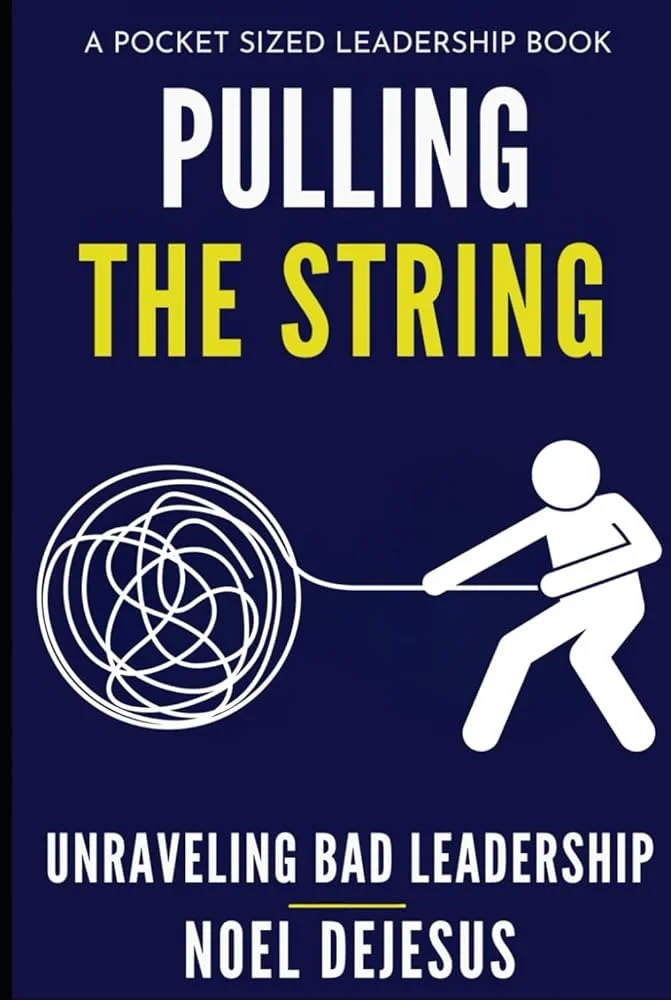
Pulling The String by Noel DeJesus
Unraveling Bad Leadership
The Bottom Line Up Front (BLUF): To succeed under poor leadership, you must first understand it.
Executive Summary
Pulling the String is a clear, practical guide that unravels twenty problematic leadership archetypes — ranging from Over-Promisers and Manipulators to Bullies, Lone Wolves, and Burnout Instigators — through concise explanations, strategies, and real-world stories from seasoned leaders. Beginning with a message of grace and the belief that leaders create leaders, the book breaks down each archetype’s traits, impacts, and solutions in a way that is both accessible and compelling. While illustrating how harmful leadership leaves lasting impressions, it emphasizes that these behaviors are common, recognizable, and navigable with the right tools. Ultimately, Pulling the String equips aspiring and current leaders, young professionals, and anyone experiencing poor leadership with the clarity and confidence to understand destructive behaviors, mitigate their effects, and grow beyond them through empathy, self-awareness, and courage.
The Content
Pulling the String begins with a statement rooted in grace: embracing imperfect leaders and recognizing that leaders are the ones who create other leaders. The following chapters describe twenty leadership archetypes, also known as undesirable leadership traits or simply descriptions of poor leaders. Fascinating yet also frightening, the author divides the twenty archetypes into manageable sections that are easy to understand and absorb. Each archetype marks a new chapter in the book, including a brief explanation of the archetype, its characteristics, impact, strategies for managing it, and real-world examples of the archetype in action, as told through the perspectives of twenty exceptional leaders.
In the book’s first chapter, the author describes the “Over-Promiser,” leaders who make ambitious commitments without doing the necessary due diligence to follow through, which creates unrealistic expectations. Brian Sanders, a 26-year Army veteran, shares his experience of working under one. Chapter Two introduces the “Manipulative Leader,” individuals who use deceit to achieve goals, undermining trust. Daylen Adams recounts his own experience serving under such a leader. In Chapter Three, readers learn about the “Censure Problem-Solver,” those who respond to inquiries with criticism, harming confidence and communication. David Cyr provides a great example and some words of wisdom. In Chapter Four, readers confront the “Dictator,” who embodies the do-what-I-say personality, which fosters unease. Natasha DeJesus shares a compelling story about this terrifying type.
Chapter Five examines the “Absentee” leader, someone who is disengaged from their teams and offers minimal guidance and support. Kyle Hogan provides an excellent example and follow-up points for reflection. Chapter Six describes the “Micromanager,” whose controlling and stifling traits are vividly portrayed through Tabitha Donnell’s perspective. In Chapter Seven, readers learn about the “Favoritism” leader, who creates division and resentment. Michael McGonigal shares his views on how this damages teams. Chapter Eight introduces the “Indecisive” leader, who struggles to make decisions. Kirk Carter explains why this archetype can be a nightmare for teams. Chapter Nine discusses the “Unethical” leader, a role that is not only unthinkable but unfortunately quite common. It describes those who ignore ethical standards in pursuit of success, sacrificing reputation and integrity in the process. Algrish Williams effectively captures this archetype. Finally, in Chapter Ten, readers learn about the “Credit Hog,” who takes all the glory and fails to acknowledge their teams. Fabian Balarezo shares his experiences to emphasize this point.
Christopher Jackson shares his experience working for the “No-Feedback” leader in Chapter Eleven, explaining why leaders who fail to give feedback hinder team growth. In Chapter Twelve, Bob Vasquez depicts the “Overly-Theoretical” leader, who focuses excessively on concepts and ideas without practical implementation, which hampers progress. Chapter Thirteen’s “The Crisis Creator” explores individuals who thrive on chaos, fostering stress and disruption. Daniel Robidou delivers a sharp lesson on this subject. Chapter Fourteen examines the “Bully” through the perspective of Tabitha Donnell, revealing how those who use intimidation and aggression create toxic environments that lead to failure. Chapter Fifteen discusses the “Out-of-Touch” leader, who is completely disconnected from their team’s realities; Kirk Carter offers strategies for managing leaders who become detached.
In Chapter Sixteen, readers will learn about the “Overly-Competitive” leader who focuses on winning, while Chapter Seventeen provides insight into the “Ego-Driven” leader, whose traits are motivated by personal priorities. Kyle Hogan and Bob Vasquez share compelling stories to highlight the ineffectiveness of both. In Chapter Eighteen, readers will explore “Neglectful” leaders who allow problems to grow unchecked, and in Chapter Nineteen, they will learn about the “Lone Wolf,” who is self-reliant and disruptive as a result. Michael McGonigal and Kirk Carter offer insights into how to handle these archetypes. In the final chapter on archetypes, titled “The Burnout Instigator,” Noel DeJesus guides readers to the finish line, helping them understand those who push their teams too hard without safeguards. The book concludes with the author reminding readers that empathy, self-awareness, and courage are vital for overcoming any of the twenty archetypes and encourages confidence that any leader can address their shortcomings through effort and humility.
Ten insightful quotes from the book
1. On bad leadership: “Bad leaders often live in blissful ignorance of their own shortcomings.”
2. On root-cause: “Bad leadership is never a surface-level problem.”
3. On action: “Leadership requires action, not mere words.”
4. On impact: “The true measure of leadership lies not in the quantity of missions accomplished but in the quality of lives enriched.”
5. On perception: “How we respond to less-than-optimal questions shapes the way we are perceived and engaged in the future.”
6. On pause: “The presence of doubt does not imply a lack of capability; it signifies a profound awareness of the weight of one’s decision and its potential impact on others.”
7. On humility: “A leader who acknowledges their limitations is more likely to seek advice.”
8. On control: “Micromanagement only undermines trust and limits growth.”
9. On bullies: “No bully, no matter how big, is too powerful to be defeated by the strength of unity and courage.”
10. Of humility: “The greatest leaders are not those who never falter but those who recognize their missteps.”
The wrap-up: why you should read Pulling the String
What does it mean to “pull the string” on something? It’s simple: to unravel it. Peel back the onion. Dig, dig, and dig some more. These are leadership basics, the 101s. Pulling the String is a book that metaphorically does all of that, and that “something” refers to twenty different problematic leadership archetypes. Most leadership books teach you what good looks like. Not this one. It does the opposite, and it does this very well. That’s the first takeaway from this review. The second is that these archetypes it pulls the string on are real — they’re present and, in some cases, quite prominent. We all recognize them and see them often in our personal and professional lives. The third thing you should know is that they’re not insurmountable. There are proven strategies to navigate them and unique ways to lessen their unwanted impacts. But to do any of that, you first need to understand what they are and why they pose a problem. That’s what Pulling the String is really all about.
I started following Noel DeJesus on LinkedIn several years ago. I knew he was a senior leader in the Army and a published author. We hadn’t met in person, but we had a mutual acquaintance named Tabitha Donnell. Tabitha, or Tabi as many call her, is a retired Air Force veteran. I connected with her through contacts, and we collaborated on a veteran employment initiative. She also helped me build The Leader’s Review™ website, and I knew she had contributed to a book with Noel. When I finally got the book, I couldn’t wait to read her section(s). She, along with many other contributors, was highlighted to show the impact of leadership archetypes, and after reading her chapters in particular, everything clicked. I remembered her describing how one specific archetype’s leadership affected her, and the impact was life-changing. But here’s the worst part: the impact is always profound. No matter who you are, where you work, how many great roles you’ve held, or how many strong leaders you’ve worked under, one thing is certain — you’ll remember the bad ones. That’s a fact. Why? Because they affect us. I remember all of mine vividly, and the authors in the book surely remember theirs, too.
But, bad leaders aren’t going away, and Pulling the String wasn’t meant to make them, either. It wasn’t really written for them. Instead, the book aims to educate those whom bad leaders attempt to lead because, typically, bad leaders aren’t really trying to get better. That’s one of the characteristics that make them bad. Pulling the String was written to say, hey, this is what bad leadership might look like; here’s how it could affect you; here’s an example; and here’s some things to consider when navigating it. And that’s what I believe Noel DeJesus wrote this book to do. Plain and simple.
Pulling the String was written for anyone who is experiencing one or more of the leadership archetypes; they will surely find this book insightful. Every aspiring and existing leader will also find this book insightful. Those curious about what it’s like to be led in the armed forces will find this book insightful. And young professionals, some of the most impressionable in our society, will find this book insightful and impactful. And here’s why: because not only will it prepare them, but it will also provide them with peace in the form of clarity. They’ll read the stories, and they’ll recognize that the leaders who authored the stories turned out just fine, often with tremendous success despite the difficult circumstances in which they were led.
And that’s the main takeaway from Pulling the String — anyone can pull the string on something, acknowledge it, and move on successfully. The best leadership books “keep the main thing, the main thing.” They don’t make you stop and wonder what you just read or bounce about the text to figure out its points; they are succinct, they are clear, and they get their message across effectively. And that’s Pulling the String.
About the book’s author
Noel DeJesus is a decorated combat veteran with multiple tours in Iraq and Afghanistan. He is an internationally published author and the founder of “Pocket Sized Leadership®,” which offers concise, actionable insights for busy professionals. As a certified training facilitator and renowned speaker, he combines his military expertise with a passion for personal and professional growth. Noel is a distinguished member of the LTG (Ret.) James M. Dubik Writing Fellowship for the United States Army and holds a Master of Arts in Administrative Leadership from the University of Oklahoma.
Follow Noel DeJesus on LinkedIn
Book details
Pulling the String
Publisher: Independently Published (March 27, 2024)
ISBN-13: 979–8880134106
FOUND THIS POST USEFUL? PLEASE SUPPORT MY WORK.
As a leader and educator, I enjoy learning, sharing, reading, and writing, which are some of my passions. Besides my love for writing, I also write to share leadership lessons. Therefore, with every book I read and summarize, I consider how its content can be applied to teams and organizations, seeking impactful insights and quotes while identifying the right audience. I actively look for opportunities to apply what I’ve learned from each book and share that knowledge to improve myself, my teams, colleagues, peers, and anyone else working toward personal and professional growth with me.
While I often personally know the authors or have built relationships with them after reviewing, nothing about this process is sponsored or previewed. As a book reviewer, I am not paid to write reviews and am not influenced in how I create them. The process involves hours of reading and reflection, making it a significant effort, so I sincerely appreciate everyone who takes the time to like my content and subscribe to follow it.
Lastly, this review contains affiliate links. As an Amazon Associate, I earn from qualifying purchases. This means I may earn a small commission if you purchase through my links at no extra cost to you.
With that, thanks for reading!
Follow Dr. Jason Motes on LinkedIn
Subscribe to my newsletter, The Leadership Tea
Visit my website